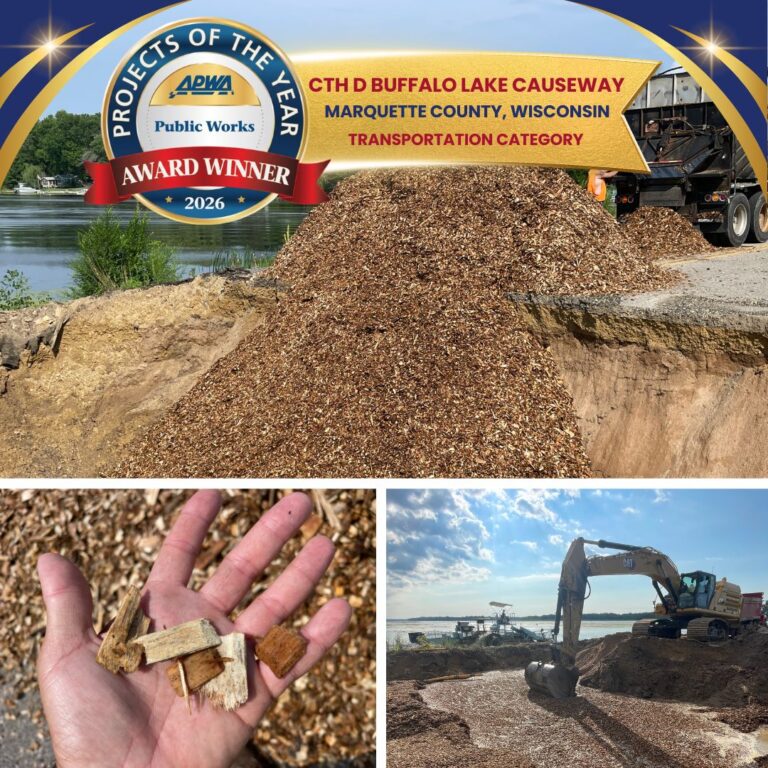
Great challenges often require bold and creative thinking, and the CTH D Buffalo Lake Causeway Reconstruction Project is a strong example of that mindset in action. Faced with unstable soils and limited budget options, the team evaluated multiple solutions in collaboration with geotechnical specialists from American Engineering Testing, Inc. (AET). Ultimately, discussions led to an unconventional but highly effective approach using wood chips as lightweight fill.
Brad Domasky was the Project Manager on the project and shared a bit about what led to the decision to use the unconventional fill material. “Conventional fill materials would lead to settlement of the soil, upwards of nine inches. This was deemed unacceptable by the client. We looked at a few options for alternatives: a pile supported bridge, geo foam, lightweight concrete, and shredded tires. While those alternatives had their positives, they also all had downfalls regarding cost and some environmental concerns. This led us to consider other options.”
Woodchips were an unconventional solution for multiple reasons, especially since this was the first documented application of this method to support a roadway in Wisconsin. The benefits outweighed the unconventionality of the material: woodchips are a renewable and lower-impact alternative to traditional lightweight fill used in projects like these. This decision reduced reliance on energy-intensive materials and minimized the project’s overall environmental footprint. Furthermore, the woodchips were sourced locally, reducing transportation distances, fuel consumption, and associated emissions.
When asked what the use of woodchips as fill could mean for future projects, Brad was hopeful. “The completed causeway exemplifies innovative solutions in an industry that often depends on tried-and-true methods and usually sticks to conventional materials. While those methods have their place, the use of an unconventional fill material for this project was best. It is exciting to think how it could be a proof of concept for future KL Engineering projects, and future projects in Wisconsin.”
This innovative solution addressed complex geotechnical challenges while remaining cost effective and sustainable. By combining research, collaboration with geotechnical experts, and lessons learned from past projects, the team helped pioneer a method that could influence future infrastructure design across Wisconsin.
We are grateful to have this work recognized with an APWA Project of the Year award in the Transportation Category for projects Less than $5 Million. This honor reflects the creativity, persistence, and teamwork that made this innovative solution possible